
NZAPT Conference 2023


Conference Plan
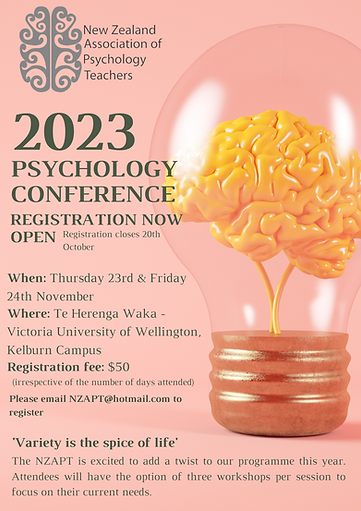
This year, we have decided to run things a little differently. Responding to feedback and recognising the differing needs between teachers new to teaching psychology and those more experienced, we offer three different workshops during each session. Below is the link to register your interest in a session to allow our facilitators to prepare resources and activities for these sessions. We encourage schools with more than one teacher attending to spread themselves between sessions so you can take advantage of what's on offer. Don't worry if you are the sole teacher. All resources from each workshop will be shared by the end of the conference.

Workshops

Key Note Speakers
Maree Hunt
Maree Hunt is the Associate Head of School - Teaching at Te Herenga Waka - Victoria University of Wellington. In her research, she uses behaviour analytic approaches to solve real-world problems, such as driver safety, gambling addiction, and student success. Over the past few years, she and her team at VUW have created a Bachelor of Psychology degree that will provide students with a foundation in psychological science that is aligned with international standards, alongside interdisciplinary majors that will allow students to explore their interests and train for a wide range of careers. In a world where most of our global challenges require changes in human behaviour, psychological science has never been more important. In this talk she will introduce the new degree, and discuss how tertiary psychology across Aotearoa is responding to the need for psychological researchers and practitioners who can apply their knowledge and skills for a better world.
Dr Tia Neha
Tia Neha is a scholar affiliated with the New Zealand Māori tribes of Ngāti Porou, Ngā Puhi, Ngāti Kahungunu, and Te Whānau Ā Apanui. She holds a PhD in Psychology and currently serves as a Senior Lecturer in Māori and Indigenous Psychology at Victoria University of Wellington. As a Māori woman, Tia dedicates herself to integrating Indigenous knowledge into academic pursuits. Her passion lies in the amalgamation of these dual perspectives (Indigenous and Western psychology), striving to weave Indigenous knowledge and scholarship into mainstream scholarship. Neha is a staunch advocate for evidence and strengths based culturally responsive research, emphasising its decolonising and applied traditional/contemporary knowledge production. Her research delves into working alongside whānau Māori (Māori communities), alongside exploring the areas of developmental, health, criminal justice, and community psychology. Her work stands as a testament of merging tradition with modernity, offering unique insights that enrich whānau Māori and academic communities. Nāku noa, nā
